The COVID-19 has slowed China's economic operation after the Spring Festival holiday.
Today, daily new diagnoses and other epidemic data have begun to decline. Under the requirements of coordinating epidemic prevention and control and economic and social development, accurate and effective resumption of work and production are being carried out in various places.
The recovery of industrial production also includes the "recovery" of social operations and the pace of life, causing the "heat value" observation data of remote sensing satellites to rise rapidly.
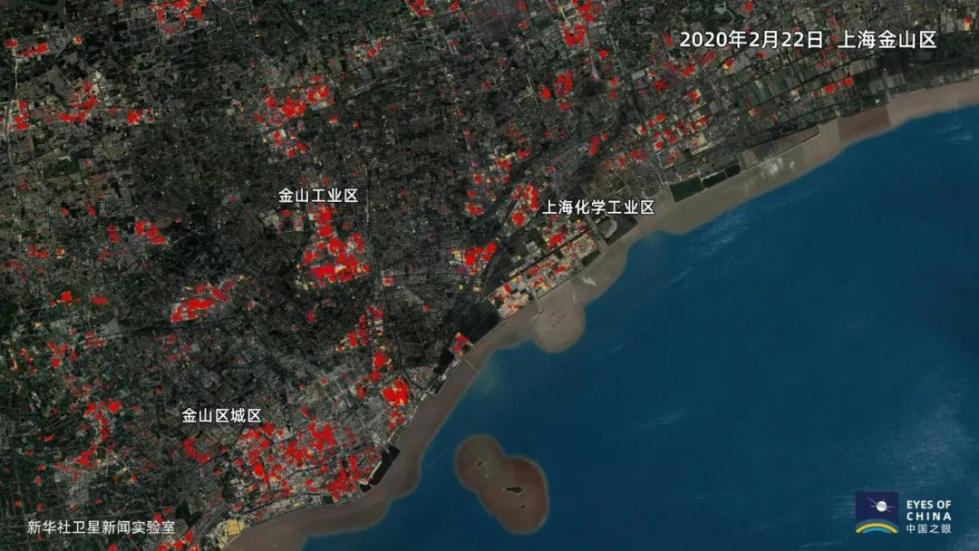
Watching the earth rapidly expand from silence to the red dot marked "heat", like a good runner temporarily dormant, gradually stretching his bones and releasing energy.
This is the Jinshan District in the southwest of Shanghai and on the north shore of Hangzhou Bay. The comparison of satellite images between the time of the Spring Festival and the recent one month has passed. Red means that the ground temperature of the place is higher than the average temperature of the entire region, usually from fires, industrial/energy production, and high-density population life and production.
On January 21, enterprises and factories started to shut down, and the migrants returned to their hometowns. The ground temperature distribution in the entire area was relatively even. On February 22, the industrial heat generated by the resumption of work and the increase in calorific value brought about by the increase in population density made Jinshan “red”.
The Shanghai Chemical Industry Zone in Jinshan District is a national-level economic and technological development zone, one of the country’s first new-type industrialization demonstration bases, and the largest and most concentrated high-level petrochemical base in Asia. The resumption of work and production of enterprises is close to 100%.
Jinshan Industrial Zone has 414 production-oriented enterprises. As of February 24, 347 enterprises have officially resumed production, with 23,431 employees. Among them, 136 enterprises above designated size have all passed the record and approval, and the resumption rate is 100%.
In the Lingang New Area of the Shanghai Free Trade Zone, as of February 24, a total of 971 enterprises had resumed work, with more than 40,000 workers returning to work. Among them, the resumption rate of enterprises with an output value of over 100 million yuan was 98.7%. Tesla's Shanghai Gigafactory has resumed work on February 10, stimulating the resumption of work and production of surrounding supporting companies.
A new car completed by the fully automated production line of Tesla's Shanghai Gigafactory
Ningbo Petrochemical Economic and Technological Development Zone (Ningbo Petrochemical District), located on the south bank of Hangzhou Bay, has been among the top three in China's chemical parks for 4 consecutive years. In 2018, the output value of above-scale was 190 billion yuan, with one 100 billion enterprise and two tens of billions enterprise. From February 9th to February 13th, more than 90% of the production capacity of Ningbo Petrochemical District was restored, and more than 13,000 employees were on duty.
At present, as an important upstream industry of the national economy, the resumption rate of China's petroleum and petrochemical industry exceeds 95%.
Maanshan Iron & Steel, located in the western part of the Yangtze River Delta, is one of China's super large steel conglomerates and the largest industrial enterprise in Anhui Province. It continues to produce during the Spring Festival. With the full resumption of work and production, this large steel plant spewed more heat.
As of February 25, 92% of the industrial enterprises above designated size in Anhui Province where Maanshan Iron and Steel is located have resumed work, and the number of workers has returned to 1.565 million, accounting for 59.5% of the number of enterprises in the province in the same period last year.
Using the visible light infrared imaging radiometer of the remote sensing satellite to observe the entire Yangtze River Delta region, the redder the color means the greater the number of thermal anomalies. This method is usually used to identify industrial combustion, as well as ground burning such as straw burning and wild fires. In the densely populated Yangtze River Delta region, this thermal anomaly mostly means the existence of industrial heat sources.
Observing the satellite data in late January and late February, compared with the Spring Festival period, the density of thermal anomalies in the Yangtze River Delta region has increased dozens of times during the week from February 19th.
As the backbone of the "world factory", the central and eastern regions of China can be seen from remote sensing satellite observation data that this vast land is rapidly "recovering".
Behind the increase in China's "heat" is a key measure for the precise resumption of work and production in different regions and levels. Although facing many challenges such as difficulty in recruiting workers, according to the data released by the provinces, industrial production in the central and eastern regions has basically resumed in about two weeks from February 10th, and cities with annual GDPs of up to trillions are also working hard to resume work at 100%.
Whether China's economy can develop steadily is not only closely related to the interests of 1.4 billion people, but also affects the global cooling and heating. The test came suddenly, and the efficient resumption of work and production in line with the needs of epidemic prevention and control is a must-answer question for China to respond to the epidemic.
The winter cold is over, and the spring breeze is getting warmer. China is "hot" and people are full of expectations!